How fast? Weight-Loss Peptide Time-Course Review
The largest losses here took months. I want those months left visible, alongside early stomach trouble, later weight checks and the question of what lasts.

Tirzepatide and semaglutide at week 72
In SURMOUNT-5 — the direct comparison of tirzepatide and semaglutide, 751 adults with obesity and without type 2 diabetes were followed for 72 weeks. Mean body-weight change was -20.2% with tirzepatide and -13.7% with semaglutide. The trial put both medicines on the same clock, in the same study population.
I admire that comparison more than a collection of spectacular percentages from unrelated trials. It answers a reasonably precise question. Yet the number that slows me down is 72: the weight result arrived after months of treatment and observation. Calling it fast without mentioning that interval leaves an oddly compressed account of what happened.
The domain name asks about speed. A calendar gives the question some substance. How long were people followed? What happened while treatment amounts rose? Were they still losing weight at the final visit? These details determine how much can be said about the pace.
Weeks in the weight trials
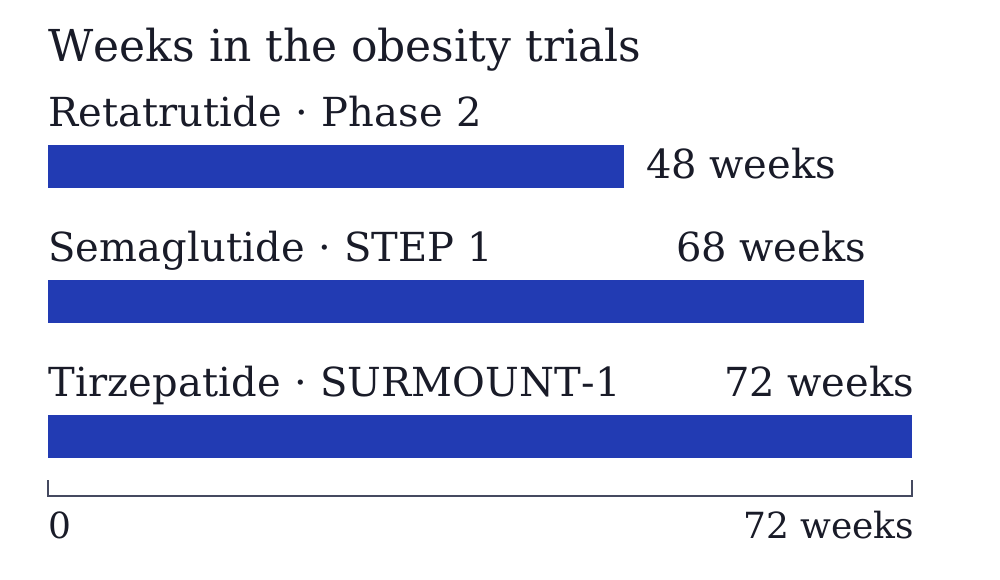
The major obesity studies in this collection ended their weight assessments at different times: 48 weeks for retatrutide, 68 weeks for semaglutide in STEP 1, and 72 weeks for tirzepatide in SURMOUNT-1. They also enrolled different groups and used different trial protocols. Lining up the final percentages as if they were entries in a race obscures those differences.
I distrust a straight-line pace inferred from a final average. A loss-per-week calculation would smooth away the very thing I came to understand: change across time. A final average says where a study group had got to when it was measured. The intervening weeks contain the trajectory.
Early tolerability
The large weight results can occupy the last line of an abstract while the uncomfortable weeks recede into its safety paragraph. In SURMOUNT-1, gastrointestinal events occurred mainly during dose escalation, the protocol’s gradual increases in treatment. Retatrutide’s digestive effects were dose-related, and its heart-rate increase peaked around week 24. The semaglutide safety review describes predominantly transient digestive trouble alongside other concerns.
I count the uncomfortable early weeks when judging the eventual average. A person can encounter the burden of treatment well before the largest measured change in weight. Tolerability has a calendar too.
After the final visit
A study can finish while weight is still changing. Its closing measurement supplies a boundary for the published result; further observation is needed to establish a plateau or what happens after treatment ends. The retatrutide review describes continuing development and unanswered longer-term questions.
There is another kind of waiting in the semaglutide kidney-outcomes trial and the cardiovascular-outcomes trial: waiting to see whether serious illness occurs. I give those results considerable weight. Faster movement on a scale would be a poor substitute for an answer about health.
Four compounds, four questions
Retatrutide has striking weight and liver-fat results measured at different visits. Semaglutide leads from a weight trial into heart and kidney outcomes. Tirzepatide offers direct comparisons in obesity and diabetes. AOD-9604 tests the expectation that a promising mouse result will eventually become human weight loss.
The trial comparison puts the study populations and observation periods together. For semaglutide TFA, fat loss research peptides and retatrutide metabolic research, the questions page deals with those terms directly.